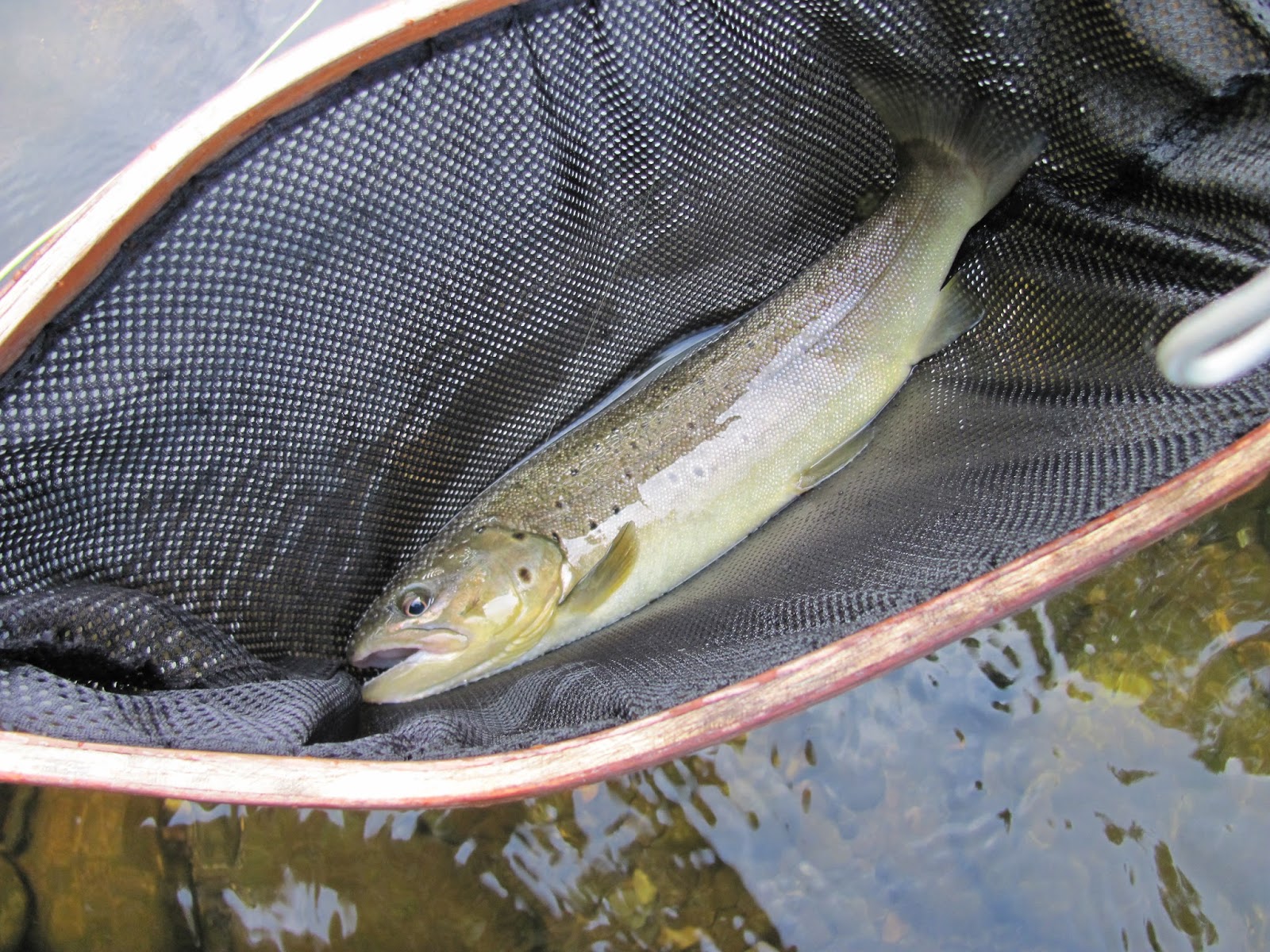
"Many of the standard flies on the river came from his vise (including some rustled patterns that now bear other peoples names). His flies were always admirably spare and simple, but now his patterns have become totally minimalist. The last batch he showed me consisted of nearly naked hooks with a little thread and a wisp of wing or a half turn of hackle: just the barest suggestion of an insect." John Gierach
One of the books that has reshaped my thinking on fly fishing and our attempts to imitate insect life is the great
What Trout Want: the educated trout and other myths by Bob Wyatt. He lays to rest the notion of the SELECTIVE trout, instead throws the blame for fly refusals on poor presentation and/or the habit of trout to key in on the dominant species as the ONLY food source at the moment.
But there is a startling revelation that is in this book that seems to be purposely overlooked and that is the sacred
Sparkle Pupa Theory
by the late Gary LaFountaine. His theory was that prior to emergence the pharate adult stage of the caddisfly expands it's outer cuticle with gas to help it in it's ascent to the surface and in the splitting of the cuticle. LaFountain believed that the gas would reflect sunlight and give a glowing or sparkling quality to this stage of the insect. That spawned his Sparkle Caddis Pupa flies which are VERY successful in catching fish.
Ok, it catches trout so whats the problem? The problem is that there is not a caddis fly in the world that emits a gas under it's shell to rise to the surface and that is a fact according to Wyatt. So what does this mean? It means that this great attempt to "match the hatch" didn't match anything but created another effective ATTRACTOR Fly.
There are a lot of attractor flies out there which includes ALL beadheads and we will be doing and reporting on an experiment within a week on this.
This weekend should be the prime time for the emergence of the of the damselfly. I've included two photos: one of the nymph snd one of the beautiful adult fly. It's the nymph which is of interest to us because it emerges onto the shore or protruding rocks to hatch. It's a fairly swift swimmer and a small, lightly dress WB in brown will do the trick. I once saw a brown beach itself chasing these nymphs.
The Millers is still fishing well and trout are still being caught. Early morning and evenings are best with the Bridge Street Pool producing well. Also producing is the big pool at the end of the road beyond Pete & Henry's in South Royalston.
The EB is prime right now but people have been asking me about the flow since the gauge went down. I have a formula to predict what the flow is up by the gorge when the gauge reading is not to be believed because of impoundment releases.
1. Go to the EB gauge site and in the upper right hand corner click "United States".
2. Choose Massachusetts from the list of states
3. Go to the map of Massachusetts and click the WB and record the flow rate
4. Go to the MB (right next to the WB) and record that flow rate
5. add the two together and you will have a very good picture of the flow upstream on the EB plus/minus 10%
NOW,WHAT OTHER FLY FISHING SITE WILL GIVE YOU THAT KIND OF INFO = NONE!!!
Charlie Shadan reports that the Squannacook and the Nissitissit rivers are low but very fishable in the early a.m. and in the evenings. (the same as it was 40 years ago!!) Some rain will fix things nicely.
I'll be on the Swift this weekend. I would guess that some trout were thrown in and now the PIPE section will be crowded again. I will miss the solitude!!
Ken