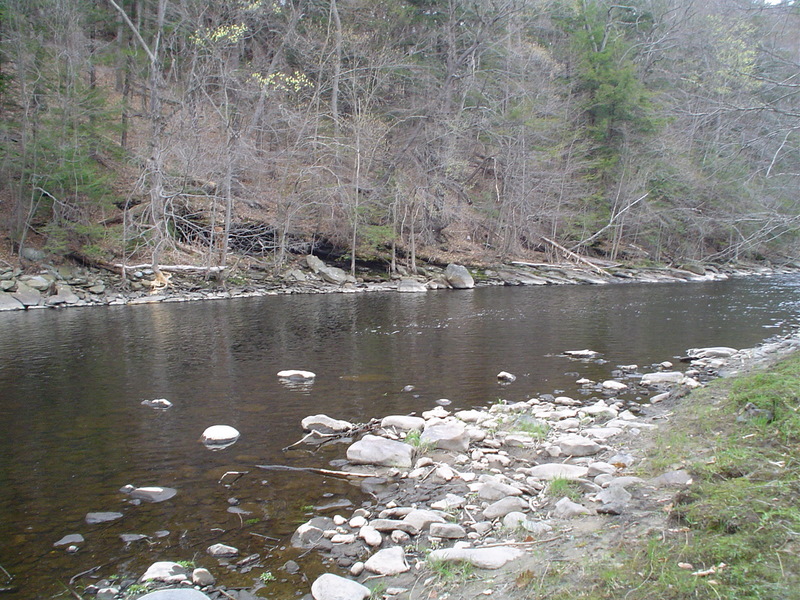
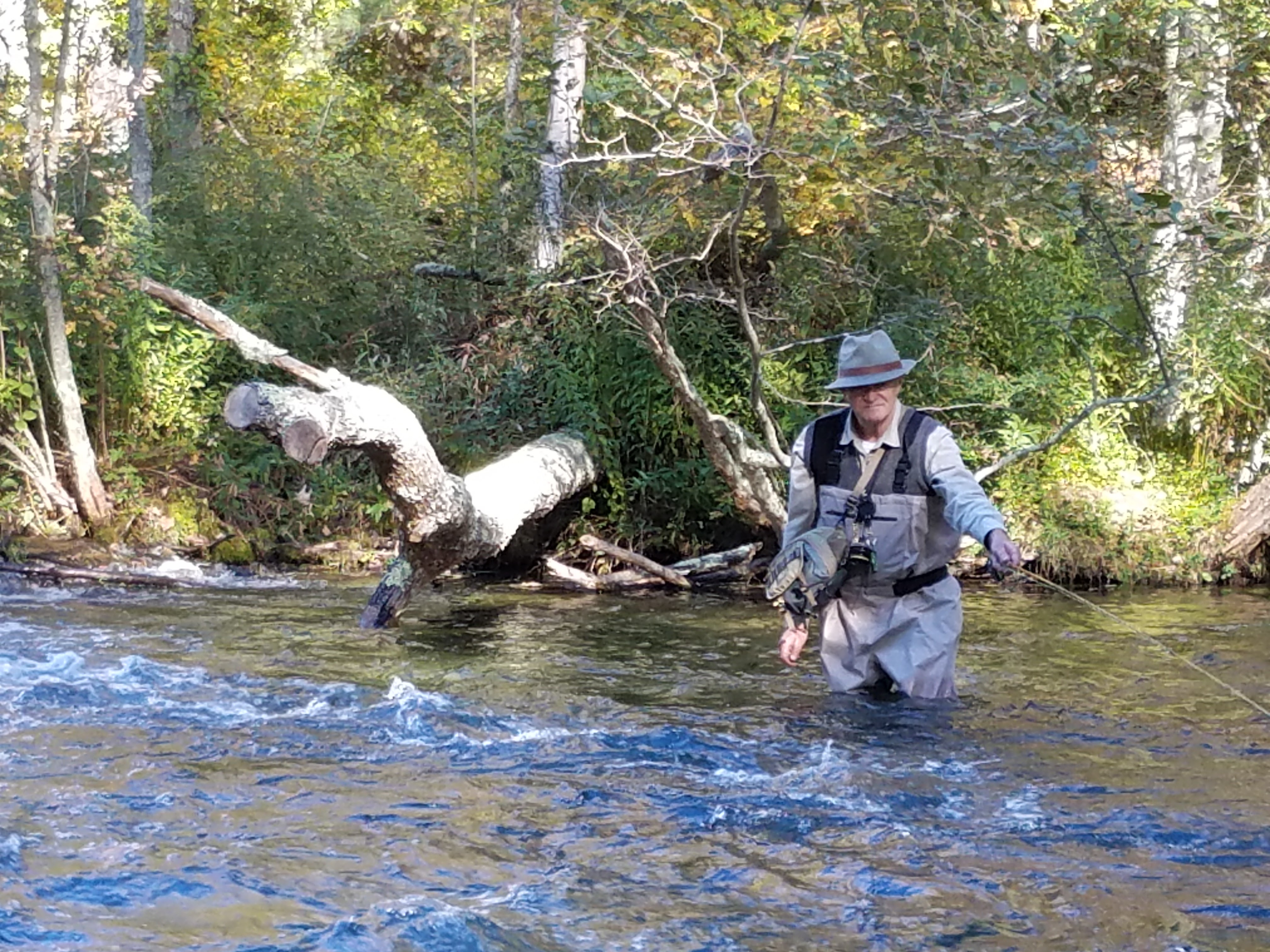
Autumn On The EB

Autumn On The EB
Showing posts with label Fly Fishers Guide To The Millers River. Show all posts

Monday, August 7, 2023

The Millers And It's Smallies

 "The fish bite twice a day - just before we get there and just after we leave" - Unknown


The Millers is a great smallmouth River and anyone who has been there can vouch for that.  Lots of "Snapper" bass in the 6 to 8 inch range are always willing to do battle with you but you may be looking for something more.  If you want larger smallies you have to ditch your trout flies and go with something bigger and heavier to get down to where these fish live. Here are a few tales of some encounters with big bass on the Millers.


The photo above is of a women I guided one hot, humid June day.  The scene is at the Bridge Street Pool in Erving and I set her up with (you guessed it) a size 10 black wooley bugger which is simply a great fly. It had a weighted body to get it down to the depths of that pool and it worked because after a 10 minute battle she cradled and released a 15 inch smallie. BTW, this pool gave up the largest SMB I've seen on the Millers that tipped the scale at 4lb!!! The hardware fisher had a single hook lure and easily released that fish.

Let's go upstream to the Kempfield Pool (just downstream from where Whetestone Brook joins in) and I'm fishing a black Marabou Leech when something BIG smacks it and tears off downstream. There is no happy ending to this story because it threw the hook after a 10 second battle but not until it tore off about 50 feet of line off my reel.  A big brown??  I think it was a big smallie.

Now, let's wade upstream to the very head of this section.  There is a HUGE boulder near the middle of the river (you can't miss it) and across from that boulder is a series of large brown rocks.  I put a large, heavy stonefly nymph against one of those rocks and had a massive hit which took line from my reel as I ran after it.  There was a flyfisher fishing right at the bend in the river and he netted my fish.  Was it the mother of all Millers brown trout?  Nope, but a 16 inch smallmouth!!!!

Then there was the time when I was fishing just below the Holtshire Rd bridge to a steadily rising fish that was tucked right up against one of the bridge supports.  Nice brown I thought as it sipped in my comparadun.  Wrong again. It was a smallie of around 14 inches that went airbourne before running out of gas after a good run.

I've caught others in that river but these are etched in my memory just like the brutes I've lugged out of Wachusett Reservoir.

There are many mid sized rivers in eastern and central Ma that have smallmouth bass and are begging to be fished.

Ken


Wednesday, May 3, 2023

My Tiny Flies


Pinheads


If you like to fish tailwaters like the Swift and the Farmington you will need the tiny flies that we like to call midges. Actually they can be Diptera (true flies), tiny Mayflies, tiny caddis flies, tiny aquatic worms and so on.  


Hot Spot

The sizes that I fish are in the 18 to 24 range.  I don't need to go down to the 28/30 range to catch these fish.  I may tie a small fly on a larger hook (28 fly on a 24 hook) which seems to fool them at times.

These flies are effective all year long, especially in the Winter although I've had great success on the Swift's Bubbler Arm on hot Summer days.

Both of these flies were invented on the Swift River!!


Ken 


Saturday, April 29, 2023

The Flies I use


"Fishermen who care too much about the size and numbers of fish they catch are insufferable on good days and as hurried as overworked executives on slow ones".  John Gierach

I don't really believe in "super flies", those semi-mythical concoctions that are supposed to work all of the time.  Many are designed to catch the attention of trout and flyfishers (an attractor) such as the rainbow warrior and not to imitate a natural stream born food item such as your basic drab nymph.  Size, shape and movement are the most important elements of fly design which is probably why the cursed wooley bugger catches so many fish.  I've been high sticking buggers upstream for a few decades and tie them with some weight and a little flash and always in black, olive or brown.  

Drifting buggers so they get down deep makes a lot of sense. They represent a food source that's found near the bottom but are often fished as a mid level streamer being pulled against the current like a baitfish which is not as effective.  That will attract freshly stocked trout but as trout wise up after being stocked that strategy begins to fail.  I remember June and July evenings on the Millers where  a small (size 12) bugger was the ticket until around dusk when I began to see rising trout and then the game changed to light colored soft hackles and then to comparadun flies when the light dimmed.

I would not venture onto a tailwater like the Swift at mid day or later during the early summer without a good supply of the fly pictured in this post.  A soft hackle Sulphur is deadly when the Sulphurs are hatching. High sticking or swinging this fly will get it done. Size 16 is the best.

Remember one thing - early season success, many times, is the result of fishing over new (dumb) fish with flies that mimic nothing that is found in the stream.  You will do well until the season changes and the water flow drops.  I LOVE LOW WATER. Many of our tight line brothers and sisters HATE that condition because those depth charge weighted nymphs sink too fast and get caught up in the weeds. A soft hackle emerger plays in that mid current zone which is what you want!!

Ken


Monday, April 10, 2023

My Toughest Trout


"I don't really know how to tie a fly until I've tied a hundred dozen of them". John Gierach


First, the toughest trout, the ones that are burned into my memory, have never been Swift or Farmington River trout but are freestone river trout such as two that I took in the Millers and the  Squanacook over a span of 20 years.   Why is that?  That's because those two trout found a spot in the Millers that they felt safe in and never left those two spots for the entire season. Their chosen spots were fairly shallow drifts with overhanging brush which meant your casts had to be PERFECT. One bad cast, and there were many, and they would be down for the day, sometimes longer.  I never really encountered that situation on tailwaters where the whole river is trout friendly. A Summer freestone has fewer friendly spots and you have to find out where they are.

A Squannacook brown took advantage of it's overhanging cover for over two months until a perfect cast of a size 16 sulphur (type) fooled that 16 inch brown.

I fished for a very reluctant brown on the Millers from early June until my October birthday. Its spot in the current was almost impossible to present a dry fly to. It was still hitting emergers even after a night time rain so I switched over to a size 16 partridge and orange SH, draped the leader over a boulder and finally hooked it.  It was only 12 inches long but if every future trout is exactly like that one I would be fine. P.S.


In short, I've caught plenty of bigger trout but not better trout.

P.S.

There's a brown on the Ware River that has found the perfect hiding place and has tempted me for two years. Maybe this year.....


Ken


Friday, March 17, 2023

The Big And Wonderful Damsel Fly


We all have our favorite fly hatches. The Sulphers on the Swift and the BWO's are two of mine on this Massachusetts  river as are the Quill Gordons on the Ware.  The Millers has so many caddis and then you dump in the stoneflies and the mid summer cahills and you can have more than you can deal with.  But the hatch that can raise my blood pressure is the Damsel Fly hatch. 

There is nothing dainty about this hatch. The adult insect is BIG and a beautiful pale green color BUT it's not the focus of our efforts. The focus is the drab nymph which emerges along the shoreline of our freestones and then climbs onto rocks and logs to hatch.  This is not an early morning event or an evening event but a mid day event on the sunniest early June day you can find. When you see the hatching insects on the shore it is time to FISH!!!

The Millers is loaded with them. I've seen trout beach themselves down by the Kempfield Pool trying to catch these nymphs.  The EB has the most and a small (size 14 curved nymph hook from Sabre hooks) can give you a double digit day.  The best thing is to get into the middle of the Bliss Pool on the EB and cast to the opposite shoreline.  During a heavy hatch you can see trout slashing around the shoreline because that's where the nymphs are!!

What to use?  Remember the hook style I mentioned above.  Tie a bugger style fly in brown or grey, cast to the shore and give it a short quick strip or two.

Forget the tailwaters because the damsels don't like them.  It's a freestone game.

Check out the photo above. You can see the beautiful adult insect and two of the casings of the nymph on the rock.

Keep tying!!!!!


Ken

Monday, March 13, 2023

The Sparkle Emerger


The solution to any problem - work, love, moneu, whatever - is to go fishing, and the worse the problem, the longer the trip should be."  - John Gierach


A great fly for the Swift and the Farmington, the Sparkle Emerger fills the bill when you need that tiny emerger to work through the riffles when the trout are working the riffles.

It is very easy to tie:

Hook- any curved scud hook will do in sizes 18 through 24

Body - I use Coats & Clark all purpose thread because it gives the fly that wonderful segmented body.  I like the color brown, black and olive in that order.

Wing Stub - 2 strands of midge crystal clipped short.

Head - tie off the body thread and switch to 12/0 black thread for the head. 

This fly has been a killer at the Pipe and the Bubbler Run on the Swift.

A big snow storm tonight.  Time to tie some flies!!

Ken

Wednesday, February 1, 2023

Tenkara Revisited

 "I fish knowing that every moment on a stream is a gift." - Unknown


It was about 15 years ago when I ran into a Swift River regular, an excellent flyfisher and fly tier, above the Pipe.  We shot the bull for a few minutes then the topic drifted over to Tenkara angling. "They hook fish but boy, do they have a hard time landing them".

Truer words have not been spoken. Tenkara, the way that it was developed in Japan, is an artform.  It was intended by Japanese anglers to fish for small trout and LL salmon in mountain streams. And it wasn't a catch and release situation.  These anglers ate these fish or sold them and their long limber rods could certainly handle the situation.

Fast forward to the present and we have tenkara anglers hooking  and, and many times, playing the trout to exhaustion. (if anglers play trout to death on the Swift with conventional tackle it will certainly happen with tenkara). The trout on our rivers are much larger  and harder to horse in.When I was guiding a tenkara angler who would hook into a 14 inch or better fish I would take position downstream with a net to end the battle quickly.  The solo angler can't do that.  Ending the battle quickly really counts on our freestone streams where higher temperatures could put that trout over the edge.

Don't hang up your tenkara rods but use them where they are meant to be used: hill country streams where the trout are 4 to maybe 10 inches long and you and catch and release quckly (if you want!)

Early Spring

Don't bet on it.  I remember the Winter of 2006/2007 where it was warm right into January but then iced up in February with huge ice dams up in the Bears Den  Only 60 days until April.


                                                                                          Bears Den Feb. 2007

Ken

P.S. Yes, Tenkara is a form of fly fishing!

Tuesday, January 24, 2023

Some Easy Tips

 "If people don't occasionally walk away from you shaking their heads, your doing something wrong" - John Gierach


When I was guiding I didn't run into many euro nyphers, in fact I ran into only two.  They wanted to explore/fish spots on the Swift that they were not familiar with so we went down to Cady Lane, a place famous for slower currents and deeper runs.  Their heavy nymphs and long leaders couldn't get the job done under those conditions. Hang ups and weeds were the catch for the first hour.  I suggested (demanded) a change of weapons for the rest of the trip - standard length leaders and unweighted flies.  We caught fish!!

Watch any video on euronymphing and you will see the same scenerio: an almost steady bank to bank stream flow over a somewhat rocky bottom with enough stream velocity to keep the fly (flies) moving. Cady Lane, which holds LOTS of trout, doesn't have those features and neither do many trout streams. Tailwaters have those features and that's why euronymphing videos feature them. 

EASY TIP NUMBER #1 Save your euro rig for the Farmington and similar tailwaters.  (Note - the Swift is a tailwater with a lot of freestone features below the Duck Pond. 

EASY TIP NUMBER #2 I see lots of indicator fly fishers casting across the stream and then mending line to avoid the dreaded drag.  Try casting UPSTREAM.  Imagine yourself standing on a clock face on the number 6. Your indicator, or dry fly indicator, should land on the number 11, 12, or 1 and then begin a drag free float right past you. I've had trout take my fly 4 feet from my legs with this method and have had trout rise for my fly as it swept past me downstream. It's a great way to cover a lot of water.

We are only 2 months away from the first day of Spring!!!

Ken


Sunday, January 15, 2023

My Favorite BWO

 "Tailwaters are what Thomas McGuane called the great theme parks of American fly fishing with their more or less stable water temperatures and articially inflated populations of insects and fish. They are irresistible for all kinds of reasons, but all of those trout breed the peculiarly postmodern sense that anything short of a 20 fish day is a bust, so when things are slow there's the temptation to lie about numbers or to vaguely allow tht you are getting your share."  - John Gierach


Back in the "old days" the BWO was tied with hackle point wings, split hackle fiber tails and with the best blue dun hackle that you could find.  Yes, it worked but it hadn't evolved into the fly that we have today.  First, it represented the "Dun" stage of the insect which is the stage that is of the least interest to the trout. You may see a trout rising over and over but you will not see a steady parade of adult mayflies disappearing into the trout's mouth. What you see is a steady stream of EMERGERS, stuck in or just below the surface. This is the "easy pickings" stage that the trout want and the modern fly provides.


Hook - use any light wire curved caddis hook. I tie mostly size 14 through 26.

Tail - NO TAIL! The rear end of this fly is usually tied with nothing but thread in the appropriate color (olive in this case) and is designed to sink below the surface.

The Wing - It's not really a wing at this stage but it is ready to pop through the surface. You want a material that floats well and is very durable.  It will keep the fly on or near the surface and that material is the finest post yarn material you can find.  Post yarn beats CDC every day.

Thorax - I use some fine rabbit to build up the fly a bit and to add some contrast to the fly (I use natural rabbit)

Use this style of tying for all of your mayfly presentations.

Tie Some Flies!!

Ken


Tuesday, January 10, 2023

Salmon in the Swift?

 "We do have to think about conservation now, although it is chilling to realize there are catch-and-release fishermen alive today who don't know how to clean and fry a fish" -John Gierach

Swift River Landlocked Salmon

It was the winter of 2018 when Quabbin overflowed in late October and sent God knows how many landlocks into the Swift River. Those brutes were still there the next summer and then the strangest thing happened - 6 to 8 inch salmon began to be caught in the Swift.

The question now is are they still there??  I've only received a dribble of reports this year (2022) and the jury is still out as to whether or not they were salmon or small browns.   Fill me in!!


The Unsinkable Soft Hackle

What happens when you combine partridge hackle (soft, flimsy and very sinkable) with very kinky high floating poly post wing material?  You get a fly that floats like a cork has very lively materials that suggest life.

Take a size 16 curved light wire hook and create a thread body from the thorax to the hook bend (2 layers of 8/0 will do.)

Take a small bundle of poly post material and tie it to the top of the hook at the thorax. Each end of that bundle should be about a 1/2 inch long. Pull the ends up tightly and then snip that material so that it flairs out as a wing.

Tie in 2 turns of partridge in front of the poly wing and you are done.

The Gierach quote at the top of this post is one of my favorites. Any other Gierach quote that values solitude over crowds does well for me. In fact, I am under the impression that most of the newbies to this sport really don't like to fish alone.  I guided one young man from Beantown who asked me if I ever had any concerns about meeting some strange charactors out in the wilds.I said no, but they should have some concerns about meeting me!

Three months until April

Ken

Thursday, January 5, 2023

Caddis Flies

 "The solution to any problem - work, love, money, whatever - is to go fishing and worse the problem, the longer the trip should be." - John Gierach


We now have over 100 years of fly fishing literature that dissects every aspect of our past time. From Theodore Gordon to Charlie Jenkins to Charles Fox to Ernest Schweibert (the list goes on and on) these flyfishers made some great advances for our sport BUT left some huge omissions and the largest is the lack of study of the Caddis Fly.

These 20th century writers were fixated by the Mayfly, especially the east coast writers who fished in and around the Catskills. They basically were dry fly anglers and May Flies provide anglers with long extended trips down the river while their wings dry. Caddis flies are a different story. They pop out of the surface and say "see ya later". No little flotilla of dainty mayflies here!!! It's a quick ride to the surface and many times with a trout in hot pursuit.

I catch far more trout on caddis imitations than the other offerings that I carry with my DMS Caddis leading the way.


Ken


Monday, January 2, 2023


Beating The Drum For The Lower Millers


I seem to do this every year around this time and that is to beat the drum for the Lower Millers. Thirty years ago I had Wendell Depot and The Bears Den practically to myself. Now they are popular destinations and that is a very good thing but the Lower Millers is pretty much the same lonesome place that it was back in the 1980's. This is where I caught my first Millers trout in 1985. It's a great place!!!

Where is it?? I consider the Bridge Street Pool as the start of it because from here downstream there is no real road access until you arrive at Millers Falls. The railroad is the only real access which means that you have about 5 miles of hoofing it to work the entire area. The above photos are of three GOOD pools that are within .6 miles of each other.

Bridge Street Pool -) third photo from the top) This is a great place and is usually the first place that I show people below Wendell Depot. Classic riffles that lead into DEEP holding water. If I had one place to fish on a May or June morning this would be the place.

Cable Pool - About a 1/4 mile below the Bridge Street Pool is the Cable Pool. The few fly fishers back in the 1980's knew what was meant by the word "Cable". This place was crisscrossed by cables with sliding gates for kayak training. The cables are long gone but the pool/run is still there and it is perfect water.

Morman Hollow Brook - Morman Hollow Brook flows into the Millers about .6 of a mile below the gauge at Bridge St and the pools in this spot are beautiful. The trout are there along with the largest smallies that the Millers has to offer.

BTW, Morman Hollow has a good population of native brookies which seem to survive even if the DFW dumps their farm raised phonies on top of them!!!

Take a break from the crowds and spend a few hours here. It's worth it!!

Ken

Thursday, December 29, 2022

My Tiny Rods And Goodbye 2022

  "I strongly suspect that much of what we believe about a particular fly rod has little basis in reality. If you're shopping for a fly rod I can think of no greater waste of your time than watching the plethora of "fly rod shoot-outs" that glut the channels of YouTube. Nothing irks me more than to listen to some dweeb prattle on about the performance pros and cons of two rods when he's obviously not a good enough caster to do either one justice". -  George V. Roberts, - Acquisitions Manager, Tail Magazine and Casting Instructor


A few years ago my friend Brad nudged me into buying a short rod, namely the CGR 5ft 9 inch by Cabela's. I hated it from the start. It had the action of a buggy whip and that's what killed it for me.  I played with the possibility of selling it but a strange quirk in my personality keeps me from letting go of any fly rod. So it went into the closet and stayed there for a few years.

Then I revisited this little blue line from my past and decided to give this rod a workout. Cabela's labeled this a 3wt but I rigged it with a Wulff Triangle 2wt and that did the trick. I was able to keep my back cast out of the trees by just roll casting. (Triangle tapers are roll casting machines) This rig may force the retirement of my Tenkara rods which are a pain in the ass on brush chocked streams. The shorter rod with the appropriate sized reel makes landing the trout easy compared to Tenkara.

I'm working on a 6 foot bamboo rod to play on the same streams. Can't wait until May.

2022

This was not a good year on the fishing front.  Let's hope for less extreme weather in 2023.  A year or two without droughts and floods would be nice.


Happy New Year!


Ken

Wednesday, December 21, 2022

Merry Christmas!!


  "No fly rod at any price is going to magically transform you into a Lefty Kreh or a Joan Wulff any more than a Stradivarius is going to turn your middle school violin student into Itzhak Perlman. And make no mistake: Itzhak Perlman could pick up a yard sale fiddle and extract soulful Tchaikovsky from it". - George Roberts, Tail Fly Fishing Magazine

It's been a strange year. The bone breaking drought last summer pretty much took the fun out of fishing my freestones and I can only take so much of the tailwater scene with the crowds and the rafts. My saltwater campaign was the worst I've ever had. (note to self: do more scouting). 

Fly tying carried me through the summer. As I've said to many that I've guided if I couldn't fly fish any longer I'd still tie flies!!

Merry Christmas, or whatever Holiday you celebrate, and have a very good New Year!!

Ken

Monday, December 12, 2022

Real Blue Lines

  "Trout are among those creatures who are one hell of a lot prettier than they need to be. They can get you wondering about the hidden workings of reality"

We hear a lot about "thin blue lines" but what exactly are they?  Here's my definition: it is a tiny watercourse that may or may not have a name and is not on the DFW stocking list. This last bit of criteria strikes a lot of gems from the list because the DFW just can't help themselves from stocking a lot of these streams with hatchery brookies and at times with rubber rainbows!


Who fishes these streams?  Well, hardly anyone to be truthful. I will mention the stream name and favorite spots on well known streams but never, ever mention or give the name and location of a thin blue line.

If you just bought a $1000 dollar fly rod you will not be seen on a thin blue line because you will not be able to show it off as you would on the Farmington. Tenkara rods, where there is no leafy canopy, and glass rods where there's a lot of underbrush, rule the day. In fact, thin blue lines demand simplicity in equipment and approach.

We could vastly improve the quality of life for self sustaining brook trout AND self sustaining brown trout populations just by stopping the stocking on these small streams.

BTW, beavers are important to wild trout survival.  A few years ago some local TU'ers declared war on those dam builders. I had a wildlife biologist from Maine declare that if beavers were harmful to wild brookies then Maine wouldn't have any wild brookies!!  Enough said!

Ken

Thursday, December 1, 2022

Favorite Spots On The Millers

 "Lawyers are like nuclear weapons. By all rights they shouldn't exist, but if some people have them, then you'd better have one too, just in case." John Gierach


I've been fishing this river for 38 years so I know something about it. I know that this river, like all freshly stocked freestones, fishes well in the Spring but really hits it's stride at dusk on a Summer evening. I would want to find myself on the Upper Trestle Pool or the Kempfield Pool, either one will do and it's all surface action.  


Don't forget morning fishing and I mean EARLY morning and that's getting on the river before 4am. (I used to live 10 minutes from the river so it was easy). This is a summer time activity because the water will be the coolest at this time of day and the surface feeding will be heavy over a short window. At 4am the water is boiling with fish but by 6am the sun is up and it's over!!

Fishing in low light means you need a fly that can be seen like the one shown above.

The Millers is a brown trout river and throwing in rainbows is a waste of time. I worked with the DFW in sampling this river in early September (twice) and all we found were browns!!!!!


Ken


Thursday, November 17, 2022

Tweaking A Wet Fly: The Millers Flymph


Two wrongs do not make a right but three do! - Anonymous


Well, the dark season is upon us and I don't like it. I've done a lot of Winter fly fishing but it was only to have something to do. No way would I give up a balmy day in May to trudge through snow and ice to wet a fly.  The great flyfishing publisher Nick Lyons once said that yes, there can be great midge fishing in Winter, but he needed the downtime of Winter and the thoughts of Spring to recharge himself.  Nothing wrong with that!

Then there's fly tying. Earlier this Fall I stated that there is no fly tying season for me because I tie all year long. During the "season" I'm busy tying inventory but in the Winter I get to experiment.  I've come up with the Millers Flymph.

Hook - light wire scud hook sizes 12 through 16

Thread - 8/0 brown

Tail (that's right) very sparse partridge fibers

Body - brown ice dubbing (don't go to the hook eye with the body but to about where the wing would be.)

Hackle - partridge (three turns)

Head - a few turns of ice dubbing again slightly pushing back the hackles.

This fly is like a soft hackle on steroids and imitates all those bigger mayflies and caddis of Spring.  I'll be stocked up by the time April rolls around.

Ken


Monday, November 7, 2022

Brook Trout Study On The Swift


Please read the following:

HI Ken - as per your recent discussions of the Swift and its wild brookies this from the GBTU chapter: PVTU Embrace a Stream Project The Swift River tailwater in Central Massachusetts is the premier wild Brook Trout fishery in Southern New England and is fished by TU members from all ten TU chapters in Massachusetts including many from GBTU. The Swift River holds up to 4000 wild brook trout per river mile, estimated by MassWildlife. Yet, Brook Trout have not been stocked in nearly 40 years. It is a virtually accidental wild fishery, created after the damming of the Swift River and the creation of Quabbin Reservoir. Pioneer Valley Trout Unlimited has been awarded an Embrace-a-Stream Grant to study the population density, movement, mortality, recruitment and growth of these wild fish. Partners include the MA Division of Fisheries and Wildlife (MassWlidlife) and the Massachusetts Outdoor Heritage Foundation. The core method of this study is the use of PIT tag technology, supervised by the MassWildlife and implemented with the help of TU volunteers. The Project will provide metrics on fishery status and viability and develop better strategies to protect Brook Trout and their environment. This study, at a total cost of $36,500, will inform not only cold-water fisheries professionals, anglers, and advocates, but the general public that support the preservation of this unique heritage. The PVTU goal for this fundraiser is $12,500 to complete the needed funding. Please support this project with a donation this week (November 7- 13) to maximize the match that PVTU will receive from TU National


Finally, we have some action on the wild brook trout population on the Swift, action that is long overdue. Let me correct a few statements mentioned above. 1. The Swift is the Premier brook trout fishery in not only Southern New England but maybe all of New England. 2. Yes, it is a tailwater (artificial) fishery BUT no other New England tailwater matches it's ability to produce large brookies. 3. It's fame is not just local as I have guided fly fishers from up and down the eastern seaboard, the mid west and Europe. They had all heard of the Swift.


Now, why did I include the photo of the monster brown from the Swift.?  That's just to remind everyone that we should be taking care of these trout too. I know that they are not NATIVE (They are European origin) but they capture the minds of all fly fishers and have coexisted with brookies in this river for decades. They are the perfect apex predator. They are needed to keep the brookies at a healthy level.

If both species are to be studied to improve their stream environment then I totally support this action and you should too.


Wednesday, November 2, 2022

Not The Fly Tying Season, Some Tasty Food And A Lost Fly Box

 "Fishermen who care too much about the size and numbers of the fish they catch are insufferable on good days and as harried as executives on slow days.  On the other hand, it's possible to be a happy angler who doesn't catch many fish; it's just that no one will ever say you're good at it." - John Gierach


I recently cruised through a fly fishing website that said that the fly tying season has begun.  "WHAT"?? The fly tying season has no beginning and has no end. When I guided I told countless clients that if I couldn't fly fish again I would still tie flies. That the tying of a henderick emerger or dry transports me to to that time of season, same with tying sulphurs or ants.  As that fly takes shape in my vise I begin to recall the great moments with that fly and that is almost as good as the actual fishing.

I tie flies almost every day, from streamers to tiny stuff. I tie flies that I only use on certain rivers because they only seem to work there and not really anywhere else. I have a small box for the Millers, the Swift and the EB which makes things very simple for me.  It also works well!!


Tuna On Thai Noodles With Snow Peas And Zucchini

Season the tuna really hard with pepper and some soy sauce and sear each side for a minute. I throw basil on the noodles and vegetables.  It's SO good!!


The Flows

Millers - 463 cfs Fishable

Swift - 122 cfs I'm worried about brookie spawning

EB - 98 cfs = It's good


Fly Box- A small grey fly box was lost above route 9. Contact me and I'll contact the owner.

Ken

Friday, October 28, 2022

The Copper Grouse Revisited


"Nobody goes there anymore, it's too crowded" - Yogi Berra 


This may be my best fly for Fall run brookies and browns. The Copper Grouse has all the right elements to be a great fly - sparse grouse or partridge hackle, a copper body and an orange fur thorax.  Sizes 14 and 16 get it done.  


The Rivers

Things are a little screwy out there.  The Millers is roaring at 760 cfs, the Ware is calm at 155cfs, the Westfield is perfect at 132 cfs and the Swift is too high for my taste at 122cfs. I've always felt that 50 to 60 cfs is best for that stream and it'd spawning brookies.

BTW, the USGS has launched its new, enhanced stream data site and IMHO it's a great improvement.  Check it out!


We have one month of Fall fishing left. That Fall season ends when the first snow sticks to the ground.  Then it's Winter and that's another season with its own rules and strategies!!


Ken